
Of all the places I imagined living when I was young, Spain never crossed my mind. In the Mexico of my childhood, there was a strong nationalistic resentment toward Spaniards. And while it’s true the conquistadores were absolutely monstrous, most of us—by some estimates, 90%—are descended from them. Genetically, I’m nearly 75% Spaniard. Still, I would have never predicted that I would end up here.
To start with, I didn’t visit Spain until I was in my early 20s, and even that was unplanned. At the time, I was “studying” abroad in London, though really, my semester was mostly spent occupying the art college in protest of neoliberal education cuts and drinking at the nearest pub. One of the few legitimate school activities I actually participated in was a trip to Barcelona, and I only joined because the English girl I was dating was going.
On our first night there, I found myself playing translator between my fellow students and some curious Spaniards at a bar. At one point, a drunk local turned to me and said, “You speak Spanish very well!” “I’m Mexican,” I explained. He nodded and replied, “Even so.” I started to understand why that old Mexican resentment lingered for so long.
The next day, a Roma woman approached our group at Montjuïc Cemetery and insisted on reading our palms. As I translated for one of the students she turned to me and took my hand. With a serious expression, she said, “You are not from here.” How she managed to figure that out with my Mexican accent and the fact that I was surrounded by blonde Brits remains a mystery to this day.
A couple of weeks later, my brother flew into London from Dallas for a visit. He wasn’t particularly impressed with the English (“They either have no chin or their chins are too big,” he declared), so we quickly set off for France and Italy for a few days before ending back up in Spain. I had lobbied for Berlin, but he wanted Barcelona, so we compromised with a stop in Madrid. As soon as we got off the train a junkie hit us up for money for heroin.
By the time we got to Barcelona, we were exhausted. To make matters worse, we were staying at a hostel that would kick us out after breakfast and not let us back in until night. We spent our days aimlessly wandering the city looking at the architecture, smoking cheap cigarettes (I had just picked up the habit in London), and talking in fake Spanish accents. The only thing I remember clearly from that visit is ordering a sandwich and saying yes when the guy at the counter asked if I wanted tomato—only to watch him rub a cut tomato onto the bread.
I wouldn’t visit Spain again for another decade, when the New York art gallery I worked at took part in ARCO, the country’s biggest art fair. As usual, we were setting up our booth at the very last minute, and just as I was looking forward to running back to the hotel for a much-needed shower, a swarm of security guards showed up and informed us that King Juan Carlos was coming for a preview. In filthy, sweaty clothes, I shook hands with my first and probably last royal. I’m glad I couldn’t hear what my boss, the gallery owner, said to the King. He was the kind of person who, when asked if he speaks Spanish, always replies “un poquito,” even though that’s the full extent of his knowledge. To make matters worse, he had started to lisp every S sound indiscriminately, convinced it made him sound like a native.
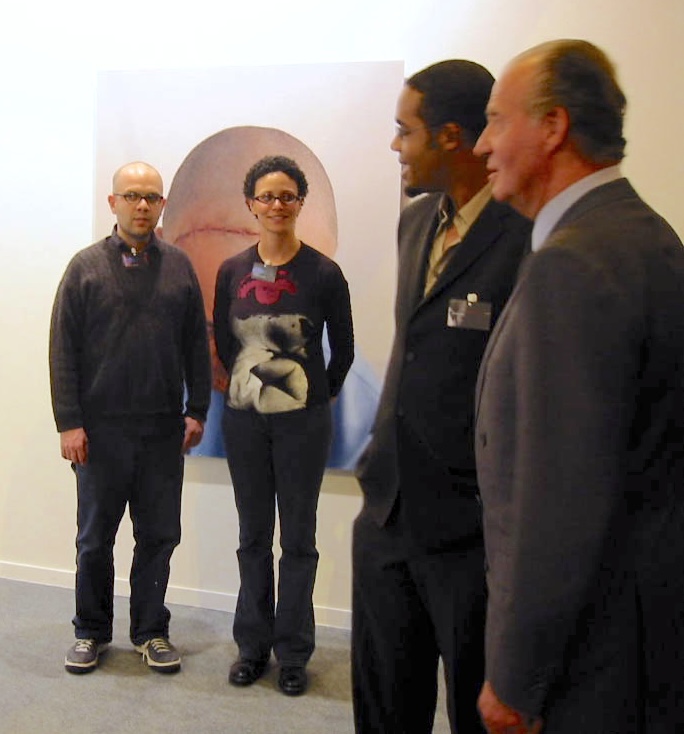
After that historic encounter, I cleaned up, put on a suit, and took over managing the booth while the owner made the rounds and socialized. Then, a TV crew showed up and a man in a loud sports coat and a mic leaned in and asked, “Since you know so much about contemporary art, how much would you say this is worth?” Then, with a flourish, he produced a store-bought garden gnome in a flower pot.
I knew he was taking the piss, so I just played along. With a straight face, I compared his gnome to Paul McCarthy’s sculptures and Duchamp’s readymades, praising its transgressive qualities. I may have even thrown out a generously high estimate of its monetary value. I never got to see the segment air, and nobody asked for other appraisals.
Back home in New York, I was invited to visit the International Studio & Curatorial Program in my role as a gallery director. At one studio, I met a conceptual artist from Madrid. We chatted in Spanish and seemed to hit it off. (It was clear she hadn’t seen my TV debut.) Before I left, decided to ask her out on a date. But as I started to speak I realized I had no idea how to do that in Spanish. The easy rapport we’d had earlier crumbled as I started stammering like a nervous teenager. She gave me her phone number, but I was so mortified I never called. Serves her right for what her people did to my people.
Many years later, my wife and I traveled through southern Spain to explore its Muslim heritage—the colorful tile work, ornate ceramics, and beautiful palaces—and the warmth and friendliness of the people left a lasting impression. We returned to explore the north and found it charming, but it was Andalucía that won our hearts. So when we no longer felt welcome in the U.S., there was only one place we considered calling home.
Unfortunately, King Juan Carlos has been living in self-imposed exile in Abu Dhabi since 2020, following allegations of financial misconduct and other scandals. Too bad, I had really hoped to ask him what the deal is with rubbing tomatoes on bread.

 A Mexican New Yorker in Spain
Leave a comment